
The transition from sitting to standing is one of the most fundamental yet physically demanding movements in daily life. For individuals recovering from surgery, dealing with chronic weakness, or facing age-related mobility decline, this simple act can become a significant barrier to independence. For caregivers, assisting with these transfers is a leading cause of occupational injury. The solution lies in a sophisticated piece of equipment designed to bridge the gap between total dependency and full autonomy: the power sit to stand lift. This device is not merely a tool for moving a person; it is a biomechanical system engineered to respect the patient’s physiology while safeguarding the caregiver. Unlike a total lift, which handles a patient who can bear no weight, the power sit to stand variant is designed for individuals who possess some lower body strength and trunk control. It leverages the patient’s own weight-bearing capacity, turning a passive transfer into an active rehabilitation exercise.
At its core, the device functions through a battery-powered actuator that smoothly tilts the patient forward from a seated position into a standing posture. The process begins with a specifically designed sling that wraps around the patient’s lower back and under their thighs. This sling attaches to a spreader bar connected to the lift’s mast. As the lift powers up, the patient’s knees are stabilized by padded supports, preventing them from sliding forward. The lift then arcs the patient into a standing position, allowing them to pivot or step to an adjacent surface, such as a wheelchair, bed, or commode. The key differentiator from a manual sit-to-stand device is the electric motor. A manual counterpart requires the caregiver to pump a lever or crank a handle, which can be strenuous and repetitive. A power lift removes this physical strain entirely, allowing the caregiver to focus entirely on guiding the patient and managing any balance issues. The controlled, hydraulic or electromechanical movement reduces the risk of jerking or sudden stops, which can trigger a patient’s fear reflex or cause discomfort.
The Biomechanics of a Power Sit to Stand Lift: Engineering a Safer Rise
Understanding the biomechanical principles behind a power sit to stand lift illuminates why this technology is superior to manual assistance. The human movement of sit-to-stand requires a complex chain of events: trunk flexion, hip flexion, knee extension, and ankle dorsiflexion. In a compromised patient, one or more of these links in the chain may be weak or painful. A caregiver attempting to physically lift the patient often resorts to a “hip-hugging” or under-arm pull, which creates dangerous shear forces on the patient’s shoulders and lower back. The caregiver also places their own lumbar spine in a vulnerable, forward-bent posture. The power sit to stand lift circumvents this by replicating the natural movement pattern with mechanical precision. The forward tilt of the lift brings the patient’s center of mass over their feet, which is the first crucial step in initiating a stand. The knee supports prevent the patient from sliding, ensuring that the forces are directed vertically and through the skeletal structure, not through the soft tissues.
The power actuation is where the safety advantage becomes most apparent. Many models feature a slow-start and slow-stop function, eliminating the “snatch” that can happen when a manual lift is pumped aggressively. This controlled acceleration is vital for patients with osteoporosis, joint replacements, or fragile skin. Furthermore, the load cell technology integrated into many newer models provides real-time weight-bearing data. This allows a physical therapist to measure exactly how much weight the patient is placing through their legs. If a patient is “faking” weakness or if they are not progressing in their rehabilitation, the data is immediately visible. The lift itself becomes a diagnostic tool. The ability to lock the wheels during the lift ensures that the entire base remains stable, preventing the frightening sensation of the lift moving away from the patient. Finally, the battery system means that the lift is always ready for operation, without the need for a nearby wall outlet. This portability allows the lift to be used in bathrooms, transfer chairs, and even vehicles, making it an indispensable tool for a dynamic care environment.
The engineering also addresses the caregiver’s biomechanics directly. With a manual lift, the caregiver must exert significant forces to generate the lift height. Over a single shift, the cumulative effect on the shoulders and lower back is measurable. With a power lift, the caregiver’s role shifts from a lifter to a stabilizer. They simply operate the hand control and guide the patient’s torso. This profound reduction in repetitive lifting effort directly correlates with a decrease in workplace injuries. The modern power sit to stand lift is therefore a tool of preventative medicine, protecting the health of the healthcare workforce as much as it supports the patient.
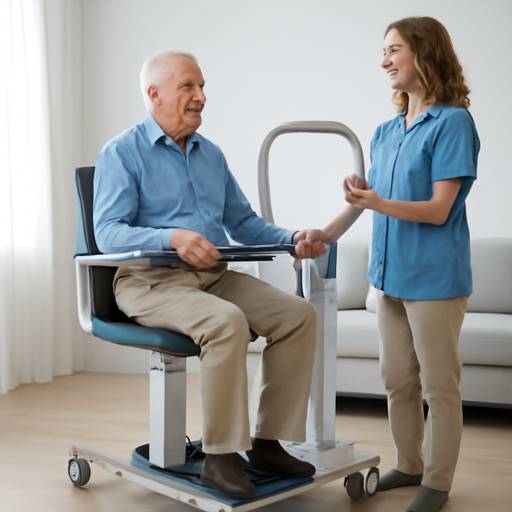
Clinical Applications and the Reduction of Caregiver Risk
The spectrum of patients who benefit from a power sit to stand lift is broad, but they share a common trait: they are partial weight bearers. This includes individuals in early-stage post-operative recovery, such as those with hip or knee replacements. For these patients, early ambulation is critical to prevent blood clots and improve range of motion, but they lack the core stability and quadriceps strength to stand independently. The lift provides the exact assistance needed, allowing them to stand and perhaps take a few steps without fear of the operative leg giving way. Another major cohort includes patients with neurological conditions like Parkinson’s disease or multiple sclerosis. These individuals may have the strength to stand but struggle with the initiation of movement (freezing) or have unpredictable balance. The power sit to stand lift provides the initial momentum and stability needed to overcome freezing, allowing the patient to complete the transfer with confidence. For bariatric patients, the power lift is often a non-negotiable necessity. The electric motor can handle significant weight capacities, often exceeding 400 pounds, which is physically impossible for most single caregivers to manage manually.
Perhaps the most significant impact of this technology is the dramatic reduction in caregiver injury rates. Data from healthcare facilities that have implemented “zero-lift” policies, which mandate the use of mechanical lifts for all non-ambulatory patients, show a reduction in staff injury claims by 40 to 60 percent. The power sit to stand lift is the cornerstone of this policy for the semi-independent population. When a caregiver uses a lift, they avoid the “caregiver’s posture” – a stooped, twisted position that places maximum strain on the L4-L5 and L5-S1 discs of the spine. The lift allows the caregiver to stand upright, using their core muscles for stability rather than their back muscles for lifting. This not only prevents acute injuries but also reduces the chronic musculoskeletal pain that plagues the nursing profession.
The psychological benefit to the patient is equally important. Being lifted by human arms can feel humiliating and foster a sense of helplessness. Using a lift that empowers the patient to stand on their own, even partially, reinforces their identity as an active participant in their care. The mechanical nature of the lift removes the awkwardness of physical contact in sensitive areas and promotes a more professional caregiver-patient interaction. The lift also provides predictable support. A patient knows exactly what the lift will do, which alleviates the anxiety of an unexpected stumble during a manual transfer. This consistency is crucial for building trust and encouraging more frequent mobilization, which directly supports faster rehabilitation outcomes.
Case Study: Reducing Staff Injuries in a Long-Term Care Facility with Power Sit to Stand Lifts
A compelling real-world example comes from a 120-bed skilled nursing facility in the Midwest. Prior to 2021, the facility reported an average of 12 staff injuries per year related to patient transfers, with the highest incidence occurring during sit-to-stand transitions. The facility’s manual lift equipment was aging, and many caregivers admitted to “eyeballing” whether a patient needed a lift, often choosing to manually assist to save time. This led to a culture of increasing risk. The physical therapy department initiated a comprehensive equipment overhaul, specifically purchasing a fleet of power sit to stand lifts to replace their manual units. The implementation was paired with a competency-based training program that mandated the use of the lift for any patient who scored a 3 out of 4 or lower on the standardized functional independence measure (FIM) for transfers.
The results over the subsequent 18 months were striking. Staff injury claims related to patient handling dropped by 67%. The facility reported zero days of lost work due to back injuries during that period. The data from the lifts themselves revealed a secondary benefit: patient mobility scores improved. Because the lift encouraged staff to transfer patients more frequently (since it was less physically demanding), patients achieved their standing goals faster. A specific 82-year-old resident with bilateral knee osteoarthritis had been resistant to physical therapy due to pain. The smooth, controlled motion of the power lift eliminated the painful torque she experienced during manual transfers. Within three weeks, she was able to stand with minimal assistance, using the lift primarily for safety. The power sit to stand lift became not just a transfer device, but a core tool in her rehabilitation plan.
This case underscores a critical point: the decision to invest in power lift technology is not merely a capital expense; it is an investment in human capital. The reduction in staff turnover, the improvement in patient outcomes, and the decrease in liability costs more than offset the initial purchase price. The facility also noted a significant improvement in staff morale. Nurses and aides reported feeling physically safer and less exhausted at the end of their shifts. They experienced less fear of injury, which translated to higher job satisfaction. This example demonstrates that the power sit to stand lift is not a luxury item for specialized care; it is a standard of care that aligns the incentives of patient safety, caregiver health, and operational efficiency. The transition from a manual to a powered system is a paradigm shift, moving from human strength to mechanical intelligence as the primary driver of safe patient mobility.
